

The modern construction sector faces an uncomfortable reckoning with its material choices. Traditional structures are notoriously carbon-intensive, driven by the energy-heavy production of Portland cement, petroleum-derived foam insulation, and intensive timber harvesting. While high-efficiency heat pumps and rooftop solar panels have dominated conversations around green architecture, operational efficiency addresses only part of the problem. The embodied carbon locked into framing, sheathing, and wall envelopes incurs a massive ecological debt before anyone ever switches on a light.
Into this dilemma steps an agricultural fiber that is quietly transforming jobsites across the country. Industrial hemp is shedding its status as an eccentric design experiment and establishing itself as a scalable, high-performance alternative to conventional building products. By combining exceptional thermal mass, natural humidity regulation, and an inherently carbon-negative footprint, hemp-based materials are giving builders a viable path to construct truly restorative spaces.
The Mechanics of Hempcrete: Dispelling the Structural Myth
To understand hemp’s practical role on a jobsite, one must first dismantle a common misconception about hempcrete, also known as hemp-lime. Despite the name, hempcrete is not a structural replacement for standard poured concrete. It possesses modest compressive strength and cannot bear heavy structural loads on its own. Instead, it functions as a lightweight, biocomposite thermal wall infill placed between and around conventional timber or steel framing.
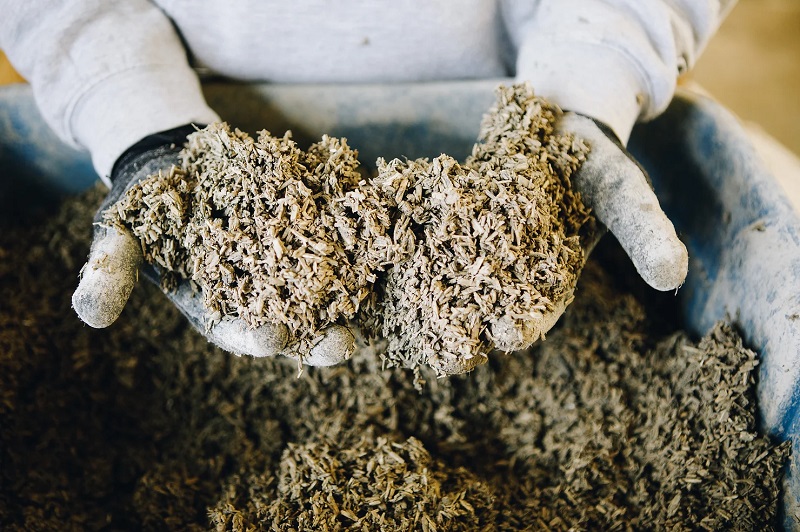
The formulation relies on three basic elements: the woody, cellulose-rich inner core of the hemp stalk—known as the hurd or shive—combined with a formulated lime binder and water. When cast in place around framing or laid using modular, interlocking blocks, this mixture forms a solid, continuous building envelope. Unlike standard stud walls filled with fiberglass and wrapped in plastic vapor retarders, a hempcrete envelope creates a seamless barrier that virtually eliminates thermal bridging.
The true thermal advantage lies in the interplay between insulation and thermal mass. Standard synthetic insulations merely slow heat transfer, but hempcrete actively absorbs excess heat during warm daytime hours and slowly radiates it inward as exterior temperatures drop. This dynamic dampening effect flattens daily temperature spikes, allowing homes to maintain steady interior climates with significantly reduced reliance on mechanical heating and air conditioning.
Moisture Regulation and the Breathable Wall System
A chronic failure point in modern residential construction is trapped moisture. In the push for airtight homes, structures wrapped in impermeable plastic barriers often trap water vapor inside exterior cavities, creating breeding grounds for rot, mold, and structural decay.
Hempcrete resolves this issue through its native vapor permeability, establishing what building scientists describe as a breathable wall system. The porous cellular structure of the hemp hurd, paired with the microscopic pathways in the lime binder, allows the wall assembly to passively absorb airborne humidity when interior levels climb and safely release it when the air dries out. This continuous buffering keeps relative humidity within an optimal comfort zone without requiring round-the-clock dehumidification.
Beyond humidity buffering, the chemistry of the lime binder provides critical protection against environmental threats:
-
Inherent Mold and Fungal Resistance: The high alkalinity of the curing lime creates an inhospitable surface for spores, eliminating the rot and mildew issues that frequently destroy drywall.
-
Pest and Insect Deterrence: Termites, carpenter ants, and burrowing rodents cannot consume or nest within the calcified matrix.
-
Fire Safety Without Toxic Additives: When subjected to high heat, the mineral coating calcifies rather than burns, allowing assemblies to earn exceptional fire ratings without the halogenated chemical flame retardants commonly added to petroleum foams.
Beyond Infill: The Expansion of Hemp Wool and Engineered Panels
While monolithic hempcrete walls appeal to custom eco-builders, the wider market requires modular materials that fit seamlessly into conventional framing schedules without altering standard jobsite workflows.
Hemp Wool Insulation
For contractors accustomed to fiberglass or rockwool batts, hemp wool insulation provides an identical form factor with none of the typical installation drawbacks. Created by carding the flexible outer bast fibers of the hemp plant into dense, springy mats, hemp wool matches the thermal resistance of high-grade fiberglass while remaining completely non-toxic. Installers can cut and friction-fit the batts between conventional two-by-four or two-by-six studs without encountering the severe skin irritation or respiratory hazards associated with glass fibers.
High-Density Fiberboards and Composite Sheathing
Manufacturing advances have also unlocked engineered hemp panels that compete directly with plywood and oriented strand board (OSB). By combining processed hemp fibers with plant-based adhesives under elevated heat and pressure, producers create rigid interior wallboards, subflooring, and acoustic baffling. These composite boards show impressive dimensional stability, excellent sound attenuation, and strength profiles that rival traditional wood products, helping relieve demand on commercial forestry.
The Carbon Equation: Converting Buildings into Carbon Sinks
What distinguishes hemp from nearly every synthetic competitor is its carbon lifecycle. During its rapid four-month growing cycle, industrial hemp pulls immense quantities of atmospheric carbon dioxide into its biological tissue through photosynthesis.
When those stalks are converted into wall infill or insulation, that biogenic carbon remains locked inside the building envelope for the life of the home. Adding to that benefit, the lime binder in hempcrete undergoes ongoing carbonation, absorbing carbon dioxide from the surrounding air over decades as it cures into limestone. While the production of concrete and synthetic insulations leaves a massive carbon deficit, a well-built hemp home functions as a net-negative carbon sink, capturing more greenhouse gas than was produced during its construction.
Navigating the Path to Mainstream Adoption
Despite clear functional and environmental strengths, the widespread use of hemp building products has had to overcome regulatory and logistical hurdles. For years, the absence of standardized building codes meant that every prospective hemp project required specialized engineering variances and lengthy negotiations with cautious municipal inspectors.
That hurdle began clearing when hemp-lime infill assemblies were formally integrated into model residential building code appendices. This standardized framework gave architects, contractors, and local code officials clear guidelines for non-structural wall installations in one- and two-family dwellings, drastically lowering the barrier to permitting.
The remaining challenge lies in the regional supply chain. Processing industrial hemp requires local decortication facilities—specialized mills that separate raw stalks into usable hurd and clean fiber. As investment in domestic processing facilities expands across agricultural hubs, shipping distances are shrinking and supply bottlenecks are beginning to ease.
The modern building industry no longer needs to treat environmental responsibility and structural longevity as opposing ideals. By pairing an ancient crop with contemporary building science, the construction trades are demonstrating that the future of low-carbon building does not depend on synthetic wizardry, but on materials grown right in the field.
